Overview
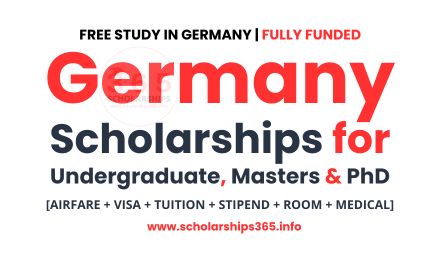
Germany offers numerous funded and fully-funded scholarships for Bachelor's, Master's, and Ph.D. degree programs at high-ranking German universities. These opportunities are provided by the German Government, various German Universities, and other organizations. Germany is a popular study destination known for its tuition-free public universities, dynamic student life, and relatively low cost of living compared to other European countries. This article compiles information on 10 prominent scholarship programs available for international students.
Coverage
Scholarship benefits vary significantly by program. Many public universities in Germany offer tuition-free education for all students, including international ones. Specific scholarships may offer:
- Fully Funded: Some scholarships, like the DAAD Germany Government Scholarships, are fully funded, covering tuition fees, a stipend, accommodation, medical insurance, travel costs, and research funds.
- Partial Funding/Grants: Other scholarships provide monthly grants (e.g., Heinrich Boll Foundation: €1,200/month for non-EU PhD, €1,350/month for EU PhD; Konrad-Adenauer-Stiftung: €850/month for graduate/postgraduate, €1,100/month for doctoral/research; Hamburg University of Applied Sciences: up to €400/month). Some may also include mobility allowances or research cost allowances.
- Tuition Fee Coverage: Jacobs University Diversity Scholarship covers full tuition fees for 3 years (Undergraduate) or 2 years (Graduate), but not room, board, or general university fees. KAAD Germany Research Fellowship covers visa modalities, return flights, German language training, tuition fees, living allowance, and accommodation allowance.
- Erasmus+: Provides grants to cover travel allowance, enrollment, and basic living expenses for exchange programs.
Eligibility
These scholarships are generally open to international students from all over the world, including non-Europeans. Ethiopian students are eligible for these opportunities. Specific eligibility criteria vary for each scholarship:
- General: Candidates must typically be eligible to pursue a degree at a state-recognized institution in Germany. Strong academic records are often a key requirement.
- Heinrich Boll Foundation: Requires outstanding academic records.
- Erasmus+: Candidates must be enrolled in a university outside Germany that has an Erasmus Charter of Higher Education agreement with a German University.
- Konrad-Adenauer-Stiftung: Requires above-average academic performance, active participation in social and community work, and interest in politics. Applicants must have completed earlier education in their home country.
- Hamburg University of Applied Sciences: For academically strong international candidates.
- Technical University of Munich & SIST LMU: For international candidates currently enrolled or registered in degree programs at the respective universities, based on academic record or proven financial need.
- University of Stuttgart: Specifically targets candidates from developing countries with professional and academic experience, demonstrating motivation to use new skills for development.
- KAAD Germany Research Fellowship: For postgraduate degree programs and academics from developing countries who are Catholic Christian or generally belong to a Christian denomination. Professional experience is also preferred.
Requirements
Specific requirements are not clearly stated for the general listing, as they vary significantly for each individual scholarship program. Generally, applicants are expected to demonstrate strong academic performance. Some programs may require proof of social engagement, specific religious affiliation (for KAAD), or professional experience (for University of Stuttgart and KAAD). Applicants should check the specific requirements for each scholarship they are interested in.
How to apply
To apply for any of these scholarships, students must visit the official website of the specific awarding institution. The article lists 10 different scholarship programs, each with its own application process. Applicants should research each program individually (e.g., Heinrich Boll Foundation, Erasmus+, Konrad-Adenauer-Stiftung, Hamburg University of Applied Sciences, DAAD, Technical University of Munich, SIST LMU, Jacobs University, University of Stuttgart, KAAD) to find detailed application instructions, required documents, and deadlines.
Notes
Germany is a safe and peaceful country, ranking 22nd globally. Public universities in Germany are tuition-free for all students, regardless of nationality. Many degree programs can be pursued in English. The best places to study in Germany include Munich, Berlin, Dresden, Hamburg, Bonn, Stuttgart, and Aachen.